A few years ago I walked into my GP for an appointment with one of my unwell offspring. The Doctor had hung a framed picture on her wall that caught my eye as it contained the Google logo. “Please don’t confuse your Google search with my medical degree”. I had a chuckle as it’s all too easy to Google the symptoms of your kid’s latest illness, and fear you’ve signed them a death warrant by visiting that soft play centre. I thought of it again recently as I read through a deck of ideas – that had clearly been written by a lazy sales person prompting into ChatGPT expecting the results to be that of a creative professional. This poor soul then doubled down on the laziness by deciding to copy and paste them directly into a ‘client ready’ deck. I shuddered.
In the ever-evolving landscape of marketing, advertising, and creative storytelling the integration of AI into creative campaign development and production is sparking a mix of excitement, apprehension, and in some cases hysteria. Let’s quickly put the new world to rights…. by automating repetitive tasks, analysing vast datasets, and generating data-driven insights, AI can free up time for creatives to focus on what they do best: ideation, storytelling, and innovation. In the same way as the now ubiquitous Adobe software helped the creative community with a suite of services that revolutionised computer aided design, development and delivery. Let’s not see AI as a threat to creativity but a catalyst, enabling us to push boundaries to deliver more impactful, audience resonant, omnichannel campaigns and experiences seamlessly and effectively. The future of creative development lies in the synergy between human ingenuity and AI’s capabilities—a partnership that amplifies, rather than diminishes, the art of creative thought.
Ben Affleck spoke very eloquently about this while being interviewed by CNBC about the effect AI might have on the creative world of film and television. My favourite line in the entire 3 mins is “craft is knowing how to work, art is knowing when to stop”. There is no doubt in my mind that the craft side of our creative and production worlds is being revolutionised by AI especially when it comes to mass ‘asset’ production, data analysis and testing / research. The demand for campaigns that seamlessly integrate outdoor, digital out-of-home (DOOH), connected TV (CTV), Social and other digital media is higher than ever, as brands are expected to deliver consistent, personalised, and engaging experiences across multiple touchpoints*. This is a challenge that requires the perfect mix of strategy, production efficiency along with time and budget awareness in order to bring a creative idea to life.
*See my buddy Adrian Skelton’s recent article for more on how CTV and DOOH are becoming bedfellows.
You only need to look at Jonathan Gudai and Adomni’s recent announcement of their “Smart Video Everywhere” offering to show you where the future of connected smart and dynamic Omnichannel AI driven campaigns is headed. In this instance the right suite of Creative Production AI tools could be transformative to campaign success as it helps reshape how creative campaigns are executed. These omnichannel programmatic media offerings allow marketeers to scale their creative production efforts without sacrificing quality and the channel/audience specific nuances… provided they do it with the right creative concept. Last week I spoke to a Marketing Director at a travel brand looking to create a campaign for a new destination. I explained how given their creative idea was solid, they might use AI to analyse which visual elements have historically driven the most engagement in different locations. Based on this data, AI could suggest tailoring the creative to emphasize the most appealing visuals for each market with the audience sensitivities, cultural differences and local conditions all playing a part in the visual end product.
I recently caught up with James Harrison after his visit to the AI Everything Global summit in Abu Dhabi. James is a global OOH expert and AI enthusiast based in the MENA market – A market where there is palpable ambition to be a Global leader in our AI driven future. “The Middle East’s strict regulations pose unique challenges for OOH ads, but AI-powered tools are ready to tackle them head-on”. Take Natural Language Processing (NLP) algorithms, for example. They can check proposed content against local guidelines before it even goes live, reducing the risk of rejection or needing big changes. This proactive approach should speed up the approval process, making campaign launches much smoother. Indeed Broadsign recently announced a feature along these lines driven by AI. James doubles down on how it’ll change things in the region. “AI is set to revolutionize how we do OOH advertising in the Middle East, making campaigns smarter, more efficient, and better connected to the people they’re meant for.” And that last point is the key I think.
AI’s strength lies in its ability to process vast amounts of data, identify patterns, and generate insights at lightning speed, which can supercharge a good idea into a brilliant execution. For creative professionals, this means less time spent on repetitive tasks like data analysis, audience insight, A/B testing, creative testing and performance tracking, and more time dedicated to ideation, storytelling, personalisation and strategic thinking and innovative concepts. If anything it’s providing a way to deliver more of what we’re really good at as intelligent humans, and what it can’t do itself.
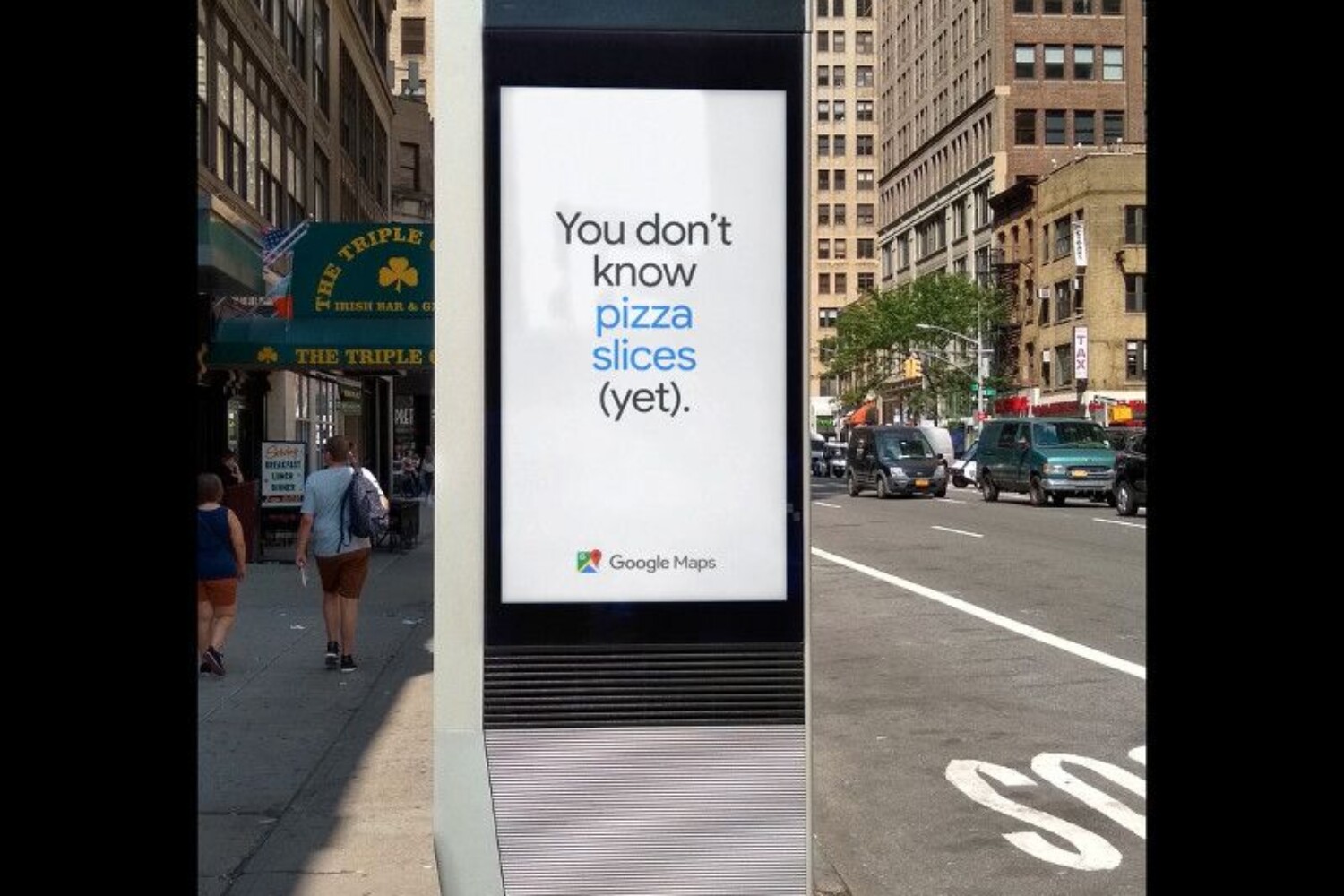
Back in the Grand Visual days when delivering data driven campaigns we had a process called building a ‘Creative Matrix’. A way of matching data, location and message. It is done painstakingly by hand by a diligent production team, the more complex the campaign, the longer it takes. Take the Google Maps Explore campaign, each location, condition and hand crafted copy line was smashed together based on each data point and potential condition we had available. Thousands of data points, hundreds of people hours. Streamlining that process with AI should mean dynamic ads from Grand Visual, DOOH.com and from the smart fellows at Flux Outdoor should push more quickly through the production cycle, driving down production costs, increasing the throughput, produce creative that resonates better with active audiences, and in turn helps to make the OOH medium more effective as a result.
On the subject of effectiveness, I love what my old stablemate Neil Morris is working on with his new Super Optimal offering – Design Intelligence for OOH. One of the most transformative applications of AI in creative campaign development is its ability to analyse and test creative concepts before they go live – as the process is based on previous successes, any established rules, regulations, along with insights, research and good old fashioned industry expertise. Traditionally, testing creative ideas involved focus groups, surveys, and A/B testing—methods that are time-consuming and often limited in scope or budget. AI, however, can analyse vast amounts of data in real time, providing actionable insights that help refine and optimise creative ideas for specific audiences, media, locations, environments, mindsets or platforms, as well as making suggestions to enhance the current offering. Super Optimal’s speciality in OOH media, locations and audiences helps elevate it over more generic systems being utilised in the space. AI’s predictive capabilities here go beyond testing, by enhancing creative ideas by identifying opportunities for improvement. For instance, AI can analyse past campaign performance to identify patterns and trends that humans might overlook. If a particular type of imagery or storytelling style consistently performs well with a specific demographic, AI can recommend incorporating those elements into new creative concepts for the human to develop further.
So back to what Mr Affleck said – while AI supported campaigns offer unparalleled efficiency and scalability (craft), it’s important to remember that creativity (art) is inherently human. Your AI might analyse data, generate insights, and even produce ‘content’ or ‘assets’, but it cannot replicate the emotional depth, cultural nuance, and originality that human creatives bring to the table. As Nils Leonard said to Hugh Todd and I on Behind the Billboard EP 58, “We’re in the remit of new, challenging, original and creativity and this is something AI can never be – as it’s inherently ‘middle’.” He went on to say “AI can’t fuck up, it can’t suffer, it can’t experience heartbreak. This is where you find the special sauce in what we do.”
The true power of AI lies in its ability to augment human creativity, not replace it. By handling the heavy lifting of data analysis, content production, and testing, AI should allow creatives to focus on what truly matters: crafting stories that resonate, spark emotions, and drive action. The future of creative development is not about choosing between humans and machines—it’s about harnessing the best of both worlds to create campaigns that captivate, inspire, and drive results.
So my creative friends, AI is not here to eat you. It’s here to feed you… so pass the special sauce.
Let’s eat.